
What Are Embedding Models? An Overview
Search has changed. A few years ago, finding information depended largely on matching the exact words in a query. Today, AI systems retrieve documents with similar meaning, recommend products based on behaviour, and answer questions by pulling information from large collections of data. These systems do not rely on keywords alone. They rely on embedding models.
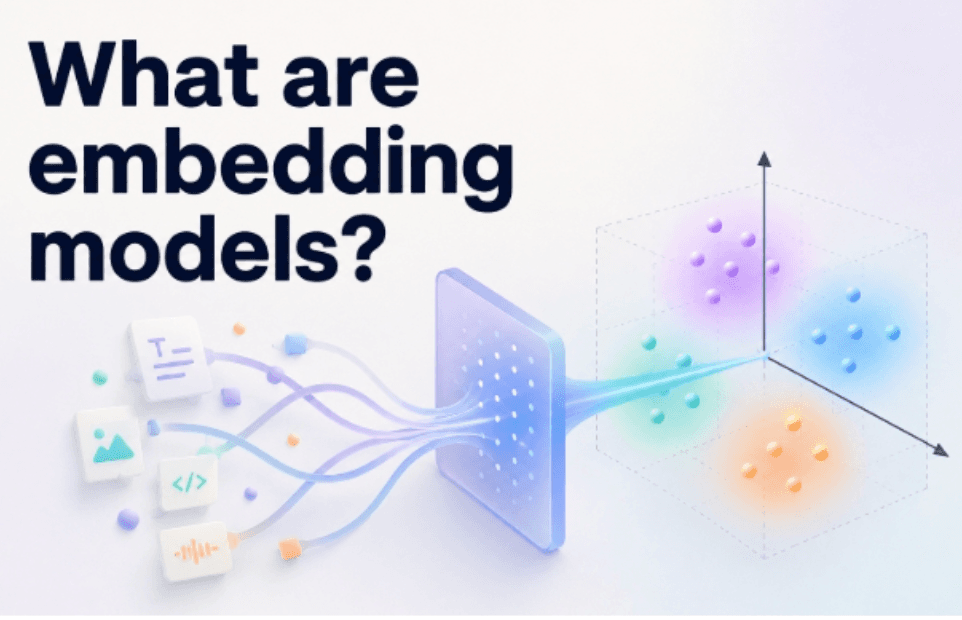
An embedding model converts text, images, code, audio, or other forms of data into numerical representations called vectors. These vectors capture relationships between pieces of information, making it possible for AI to identify similar content even when the wording or format is different.
This technology sits behind many of the AI applications people use every day. Enterprise search platforms use embeddings to retrieve internal documents. AI chatbots rely on them to find relevant context before generating responses. Recommendation engines compare vectors to suggest products, films, or songs with similar characteristics. Even reverse image search depends on embeddings rather than simple pixel matching.
What Are Embedding Models?

Embedding models are machine learning models that transform data into dense numerical vectors while preserving meaning and relationships. Unlike traditional databases, which store information exactly as it appears, embeddings represent the semantic meaning of the data. This allows computers to compare concepts instead of individual words.
Consider these two sentences:
- Book me a taxi.
- I need a ride to the airport.
Although they use different words, both express nearly the same intent. A good embedding model generates vectors that place these sentences close together in vector space because their meanings are closely related.
Now compare them with:
- How do I bake chocolate cake?
This sentence would produce a vector much farther away because it belongs to an entirely different topic. This ability to measure semantic similarity makes embeddings essential for AI retrieval systems.
Why AI Systems Need Embedding Models
Traditional search engines rely heavily on lexical matching. They perform well when users type the exact words contained in a document, but they struggle with synonyms, abbreviations, and natural language.
Suppose a customer searches for:
Affordable wireless earbuds
Your catalogue contains a product titled:
Budget Bluetooth headphones
A keyword search might miss the result because none of the important words match exactly. An embedding model recognises that "affordable" is similar to "budget" and "wireless earbuds" relates closely to "Bluetooth headphones." Instead of matching words, it matches meaning.
| Traditional Search | Embedding Search |
|---|---|
| Matches keywords | Matches meaning |
| Limited understanding of context | Preserves semantic relationships |
| Misses many synonyms | Understands similar concepts |
| Performs best on structured queries | Performs well with conversational language |
This shift from keyword matching to semantic understanding has transformed search, recommendation systems, and AI assistants.
How Embedding Models Work
Although the mathematics behind embeddings involves neural networks and high-dimensional vector spaces, the overall process is straightforward. An embedding model converts text, images, code, audio, or other data into numerical representations called vector embeddings. These vectors act as coordinates in a mathematical space, allowing AI systems to compare meaning instead of matching exact words.
For example, "Laptop computer" and "Notebook PC" produce vectors that are positioned close together because they describe similar concepts. In contrast, "Laptop computer" and "Chocolate cake" are much farther apart because they share little semantic meaning. This relationship between vectors enables AI systems to retrieve relevant information based on similarity rather than exact wording.
Step 1. Receive the Input
The process begins when the model receives an input, such as text, an image, source code, or an audio file. Regardless of the format, the goal is the same: transform the content into a representation that preserves its meaning.
Step 2. Analyse Context
The model analyses the relationships within the input rather than processing each word or feature independently. For text, it examines sentence structure, surrounding context, and the relationship between words to build a richer understanding of the content. Modern transformer-based architectures are particularly effective at capturing these patterns.
Step 3. Generate a Vector
After analysing the input, the model produces a list of numerical values that represents its semantic meaning.
[0.24, -0.83, 1.17, 0.46, ...]
This numerical representation is called a vector embedding. While the values themselves have no direct meaning to humans, AI systems compare them mathematically to determine how closely two pieces of information are related. Similarity is commonly measured using cosine similarity, Euclidean distance, or dot product, with cosine similarity being the most widely used for semantic search.
Step 4. Store the Vector
The generated vector is stored in a vector database such as Pinecone, Weaviate, Milvus, or Qdrant, together with metadata like the document title, source, publication date, or author. The original content remains unchanged, while the vector serves as its searchable representation.
Step 5. Find Similar Results
When a user submits a query, the same model converts it into another vector. The vector database compares this new vector with the stored vectors and retrieves the closest matches based on semantic similarity. Those results are then passed to an AI application, such as a Retrieval-Augmented Generation (RAG) system or chatbot, which uses the retrieved context to generate a relevant response.
Types of Embedding Models

Alt text: Crystal Data Streams: From Inputs to Networks
Different AI applications require different kinds of embeddings.
Text Embeddings
Text embeddings convert written language into vectors while preserving meaning and context.
They are widely used for:
- Semantic search
- Knowledge bases
- Enterprise document retrieval
- AI assistants
- Customer support
- Content recommendation
Popular models include:
- OpenAI text-embedding-3-small
- OpenAI text-embedding-3-large
- BAAI BGE
- E5
- Cohere Embed
- Voyage AI
Image Embeddings
Image embeddings represent visual information as vectors rather than individual pixels. Instead of asking whether two images contain identical colours, the model learns visual features such as:
- Shapes
- Objects
- Textures
- Composition
- Visual relationships
Applications include:
- Reverse image search
- Product matching
- Medical imaging
- Face recognition
- Content moderation
Models such as CLIP place both images and text inside the same vector space, making multimodal search possible.
Popular OpenAI Embedding Models and Alternatives
Several providers offer high-performing embedding models, each designed for different workloads.
| Model | Best For | Open Source | Typical Use Case |
|---|---|---|---|
| OpenAI text-embedding-3-small | Fast, low-cost retrieval | No | Search, chatbots, RAG |
| OpenAI text-embedding-3-large | Maximum retrieval accuracy | No | Enterprise AI |
| BAAI BGE | High-quality multilingual search | Yes | Knowledge retrieval |
| E5 | Semantic search | Yes | RAG pipelines |
| Cohere Embed | Enterprise search | No | Business applications |
| Voyage AI | Long-context retrieval | No | Large document collections |
Choosing the right model depends on more than benchmark scores. Accuracy, latency, multilingual support, pricing, context length, and deployment options all influence which model performs best for your application.
from openai import OpenAI

client = OpenAI()

response = client.embeddings.create(
    model="text-embedding-3-small",
    input="What are embedding models?"
)

print(response.data[0].embedding)
This example generates a vector embedding for a text input using an OpenAI embedding model. The returned vector can be stored in a vector database and used for semantic search or Retrieval-Augmented Generation (RAG).
Document Chunking: The Step That Improves Retrieval
Even the best embedding model performs poorly if documents are indexed incorrectly. Before generating embeddings, most AI systems split large documents into smaller sections, a process known as chunking.
Imagine uploading a 200-page employee handbook into a chatbot. Creating a single embedding for the entire document makes retrieval difficult because the model tries to represent hundreds of topics with one vector. Splitting the handbook into smaller, focused sections produces much more accurate results.
Several chunking strategies are common.
| Chunking Method | Best For | Advantages |
|---|---|---|
| Fixed-size chunks | General documents | Simple and fast |
| Recursive chunking | Long articles and PDFs | Preserves sentence structure |
| Semantic chunking | Knowledge bases | Groups related ideas together |
| Overlapping chunks | Technical documentation | Maintains context between sections |
For example, a user asks:
"What is your refund policy?"
Instead of searching an entire handbook, the system retrieves only the section explaining refunds. The LLM then uses this context to generate an accurate response.
Good chunking often improves retrieval quality more than switching to a different embedding model.
Embedding Models in a RAG Pipeline
Retrieval-Augmented Generation (RAG) has become one of the most common ways to build AI assistants that answer questions using private or business data.
Embedding models play a central role in this process.
Documents
↓
Document Chunking
↓
Embedding Model
↓
Vector Database
↓
User Question
↓
Question Embedding
↓
Similarity Search
↓
Relevant Documents Retrieved
↓
Large Language Model
↓
Final Response
Here's how the workflow looks in practice.
- Documents are divided into smaller chunks.
- Each chunk is converted into a vector.
- The vectors are stored in a vector database.
- A user's question is also converted into a vector.
- The database finds the closest matches.
- Those results are sent to the language model.
- The language model generates a response using the retrieved information.
Without embeddings, the retriever would depend largely on keyword matching, making answers less accurate. If you're building AI applications with multiple providers, platforms such as Tokenware simplify access to embedding APIs alongside large language models through a single interface. This makes it easier to experiment with different models without changing your application code.
Hybrid Search vs Semantic Search
Many organisations assume embeddings replace keyword search. In practice, the strongest search systems combine both approaches.
Semantic Search
Semantic search compares vectors to retrieve information with similar meaning.
Example:
Search query:
Affordable smartphones
Retrieved result:
Budget mobile phones
Although the wording differs, the intent remains the same.
Hybrid Search
Hybrid search combines:
- Keyword search
- Vector search
This approach retrieves documents based on both exact matches and semantic similarity.
| Feature | Semantic Search | Hybrid Search |
|---|---|---|
| Uses embeddings | Yes | Yes |
| Uses keyword matching | No | Yes |
| Handles synonyms | Excellent | Excellent |
| Finds exact product names | Limited | Excellent |
| Enterprise search | Good | Excellent |
Many enterprise search platforms use hybrid search because it performs well across technical documentation, product catalogues, and customer support content.
Common Applications of Embedding Models
Embedding models support far more than chatbots. They have become a core technology across many industries.
Semantic Search
Semantic search retrieves documents based on meaning rather than exact wording.
Businesses use it for:
- Knowledge bases
- Internal documentation
- Legal research
- Customer support portals
Recommendation Systems
Streaming services and online retailers compare vectors to recommend similar content.
Examples include:
- Movies
- Music
- Books
- Products
- News articles
Rather than matching categories, the system compares similarities between user behaviour and available content.
Image Search
Image embeddings make reverse image search possible. Instead of comparing pixels, AI identifies similar objects, colours, patterns, and layouts.
Applications include:
- Fashion retail
- Medical imaging
- Digital asset management
- Copyright detection
How to Choose the Right Embedding Model
No single embedding model is the right choice for every application. The best option depends on the type of data you want to process, your performance requirements, and how you plan to deploy it. Evaluating these factors helps you select a model that delivers accurate retrieval while balancing cost and scalability.
Choose a Model Based on Your Data
Start by identifying the type of data your application will process. If you're building a semantic search engine or RAG application, text embeddings are typically the best choice. Applications involving visual search or image recognition require image embeddings, while some multimodal models support both text and images within the same vector space.
Consider Accuracy and Performance
Different models offer different trade-offs between retrieval quality and speed. Enterprise applications often prioritise accuracy, while real-time systems such as chatbots or search assistants require lower latency. Comparing several models using your own dataset usually provides a better indication of performance than relying only on public benchmarks.
Evaluate Vector Dimensions
Every model generates vector embeddings with a fixed number of dimensions, such as 384, 768, 1,536, or 3,072. Higher-dimensional vectors often capture more semantic information and improve retrieval for complex datasets, but they also increase storage requirements and search costs. Lower-dimensional vectors generally provide faster retrieval and require less storage, making them suitable for smaller workloads.
Check Language and Deployment Support
If your users search in multiple languages, choose a multilingual model that supports cross-language retrieval. You should also decide whether to use a hosted API or deploy an open-source model. Hosted services, including OpenAI embedding models, simplify deployment, while open-source alternatives provide greater control over infrastructure and customisation.
Test With Your Own Data
The best-performing model depends on your documents, queries, and users. Before deploying to production, evaluate multiple options using your own dataset and measure retrieval accuracy, latency, storage requirements, and overall cost. This approach provides a more reliable basis for choosing an embedding solution than benchmark scores alone.
Conclusion
Embedding models have become a foundation of modern AI, helping systems understand the meaning behind text, images, code, and other data instead of relying on keywords alone. Whether you're working with text embeddings, image embeddings, or OpenAI embedding models, understanding how they create vector embeddings is essential for building accurate search, Retrieval-Augmented Generation (RAG), recommendation systems, and AI assistants.
As AI applications continue to evolve, knowing what embedding models are and how they fit into the AI pipeline will help you build more reliable and scalable solutions. Mastering these concepts provides a strong foundation for building search, recommendation, and retrieval systems that scale with both users and data.
Frequently Asked Questions
1. What is the purpose of vector embeddings in AI?
Vector embeddings represent data as numerical vectors, allowing AI systems to compare meaning and retrieve similar content instead of relying on exact keyword matches.
2. Are OpenAI embedding models free to use?
No. OpenAI embedding models are available through the OpenAI API and are billed based on token usage.
3. Can text embeddings work with PDFs?
Yes. PDFs are typically split into smaller text chunks before text embeddings are generated for semantic search and Retrieval-Augmented Generation (RAG).
4. Do image embeddings recognise objects in a picture?
Not directly. Image embeddings capture visual features and relationships, allowing AI to compare images based on similarity rather than identifying every object individually.
5. Which vector database works best with embedding models?
Popular options include Pinecone, Weaviate, Milvus, Qdrant, and Chroma. The best choice depends on your scalability, deployment, and performance requirements.
6. Can vector embeddings improve recommendation systems?
Yes. Recommendation engines use vector embeddings to identify users, products, or content with similar characteristics and preferences.
7. Are text embeddings better than keyword search?
For semantic retrieval, yes. Text embeddings understand context and intent, while keyword search performs better when exact matches are required. Many applications combine both approaches.
8. Can embedding models be fine-tuned?
Some open-source embedding models support fine-tuning with domain-specific datasets, improving retrieval performance for specialised applications.
9. How do developers measure the quality of text embeddings?
They typically evaluate retrieval accuracy using benchmark datasets or by testing how well the embeddings return relevant results for real user queries.
10. What makes OpenAI embedding models popular?
OpenAI embedding models are widely adopted because they deliver strong retrieval performance, support a wide range of AI applications, and integrate easily with modern AI development workflows.