
AI Agent vs Chatbot: What Are the Key Differences?
Businesses exploring AI often face the same question: AI Agent vs Chatbot, what's the difference?
At first glance, the two technologies can seem similar. Both interact with users through natural language, and many modern systems are powered by a Large Language Model (LLM). However, their capabilities, level of autonomy, and business applications differ significantly.
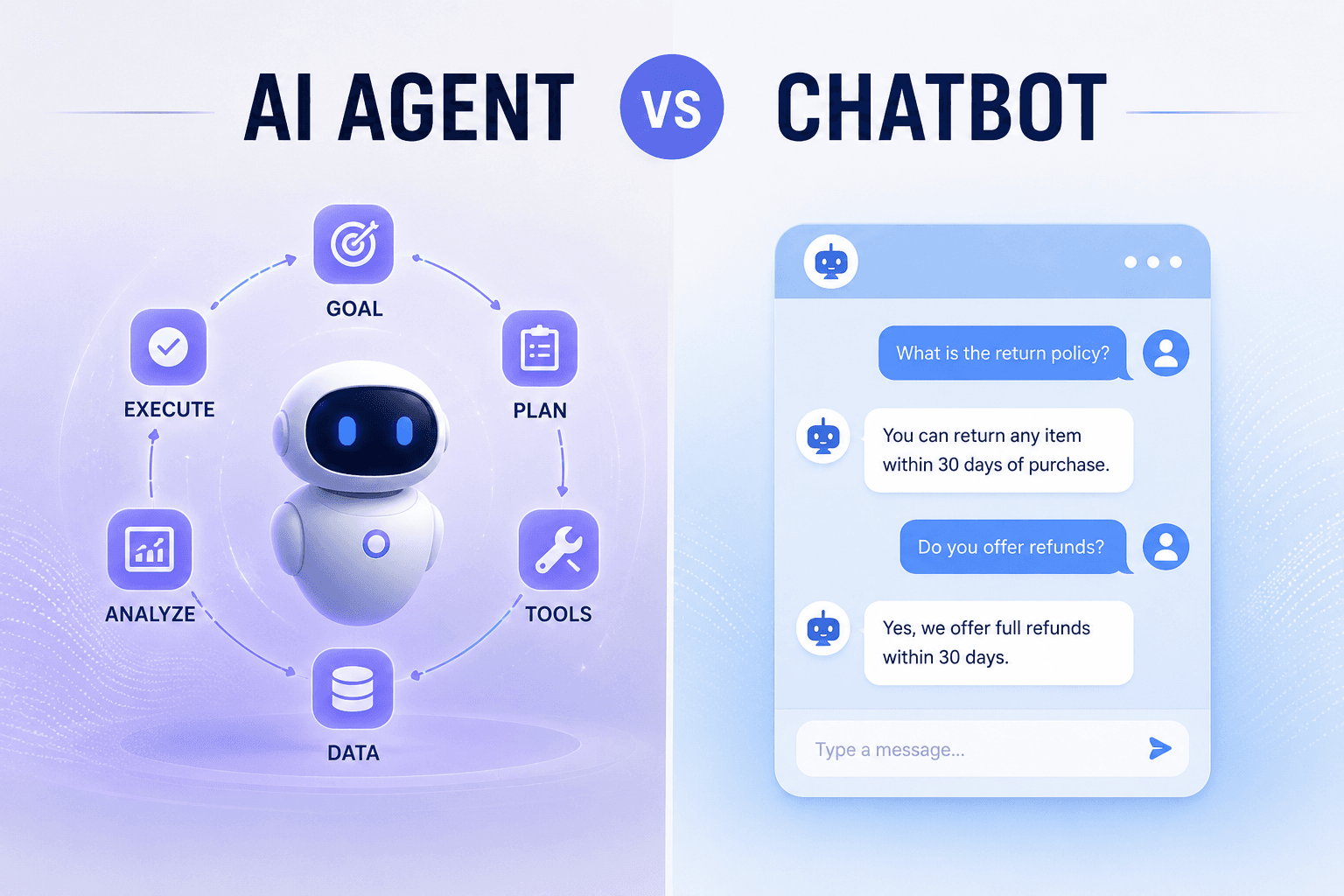
A traditional chatbot is designed to answer questions, provide information, and guide conversations. An AI agent goes further by planning tasks, making decisions, using external tools, and completing multi-step workflows with minimal human involvement. Understanding these differences is important when evaluating AI solutions for customer support, workflow automation, sales operations, or internal business processes. In this guide, you'll learn how AI agents and chatbots work, where prompt engineering fits into each approach, and which solution is best suited for your specific use case.
AI Agent vs Chatbot
A chatbot is designed primarily to communicate with users through text or voice interactions. Its main role is to answer questions, provide information, and guide conversations.
An AI agent is designed to achieve goals. Beyond communication, it can analyze information, make decisions, interact with software systems, and execute tasks across multiple steps.
Simply put:
- Chatbots focus on conversations.
- AI agents focus on outcomes.
AI Agent vs Chatbot: Side-by-Side Comparison

| Feature | Chatbot | AI Agent |
|---|---|---|
| Primary Purpose | Conversation | Task Completion |
| Autonomy | Low | High |
| Decision Making | Limited | Advanced |
| Memory | Session-Based | Long-Term Context |
| Tool Usage | Limited | Extensive |
| Workflow Handling | Single-Step | Multi-Step |
| Problem Solving | Basic | Advanced |
| External Integrations | Simple | Deep Integration |
| Human Supervision | Frequent | Reduced |
| Business Impact | Support Automation | Process Automation |
What Is a Chatbot?
A chatbot is a software system used in the AI Agent vs Chatbot comparison to handle conversation tasks. It interacts with users through text or voice and delivers answers or simple actions.
A traditional chatbot relies on rules, decision trees, and predefined paths. It matches keywords and returns scripted responses. It fails when user input moves outside expected patterns.
Common examples include:
- What are your business hours?
- Where is my order?
- How do I reset my password?
Modern chatbot systems use a Large Language Model (LLM) to process language and generate responses. This improves flexibility and context handling, but the focus stays on communication, not task execution.
Use cases include:
- Customer support
- FAQ handling
- Lead generation
- Appointment booking
What Is an AI Agent?
An AI agent is an autonomous system used in the AI Agent vs Chatbot comparison to execute tasks and achieve goals. It goes beyond conversation and focuses on outcomes.
Unlike a chatbot that responds to user input, an AI agent analyzes a goal, plans steps, and decides how to complete it.
Example:
Find the three best marketing automation platforms for a small business, compare pricing, and summarize findings.
A chatbot may list general options. An AI agent breaks the task into steps, searches for information, compares results, and produces a structured output.
AI agents often use a Large Language Model (LLM) together with tools, APIs, databases, memory systems, and workflow engines. This allows them to act, not only respond.
Common use cases include:
- Research automation
- Data analysis
- Sales workflows
- Customer service automation
- Task execution
Traditional Chatbot vs AI Agent
Before modern AI systems became popular, most businesses relied on a traditional chatbot to handle customer interactions.
A traditional chatbot operates using predefined rules, decision trees, and scripted responses. When a user asks a question, the chatbot searches for matching keywords and returns a pre-programmed answer.
For example, if a customer types:
"Where is my order?"
The chatbot may provide tracking information.
If the customer asks:
"Can you compare my previous orders and recommend the best product based on my purchase history?"
A traditional chatbot will likely fail because the request falls outside its predefined rules. AI agents operate differently. Instead of following fixed scripts, they can reason through requests, access external systems, retrieve information, and determine the steps needed to complete a task. The shift from traditional chatbot technology to AI agents represents one of the biggest changes in business automation. Organizations no longer need systems that only answer questions. They increasingly need systems that can perform work.
How Chatbots Work
Understanding how chatbots work makes it easier to see where their limitations begin. A typical chatbot workflow looks like this:
- User submits a question
- The chatbot interprets the request
- The system searches its knowledge source
- A response is generated
- The answer is returned to the user
In most cases, the interaction ends there. Even modern AI chatbots powered by a Large Language Model (LLM) primarily focus on generating responses rather than executing actions.
For example, a chatbot may explain how to book a meeting but often cannot schedule the meeting itself without additional integrations. The chatbot's primary objective is communication.
How AI Agents Work
 AI agents follow a goal-driven workflow in the AI Agent vs Chatbot comparison. The process starts when the user provides an objective.
From there, the agent breaks the goal into steps, selects tools, gathers information, executes actions, checks results, and adjusts when needed until the task is complete.
Example:
Research the top CRM platforms for small businesses and prepare a recommendation.
An AI agent typically:
- Searches CRM providers
- Collects pricing data
- Compares features
- Organizes findings
- Produces a final recommendation
The user defines the goal. The AI agent decides the process and completes the work. This separates AI agents from chatbots, which focus on responding rather than executing tasks.
8 Key Differences Between AI Agents and Chatbots
1. Purpose: Communication vs Execution
The most important distinction lies in purpose.
Chatbots are designed to communicate with users. Their objective is to answer questions, guide conversations, and provide information.
AI agents are designed to complete objectives. Communication is often part of the process, but execution remains the primary goal.
For example, a chatbot might explain how to submit an expense report.
An AI agent might collect receipts, complete the expense form, submit it, and notify the finance team.
2. Autonomy
Chatbots depend heavily on user instructions. Each interaction typically starts when a user asks a question or submits a request.
AI agents operate with greater autonomy. After receiving a goal, they can determine the steps required to achieve it without requiring continuous user guidance.
This autonomy allows agents to manage complex workflows and adapt when circumstances change.
3. Decision-Making Capability
Most chatbots respond to prompts without making meaningful decisions. AI agents evaluate information, compare alternatives, and choose actions based on objectives and constraints.
For instance, an AI travel agent might compare flight prices, departure times, and hotel availability before recommending an itinerary. The system actively evaluates options rather than simply presenting information.
4. Tool Usage
Chatbots primarily generate responses. AI agents use tools.
These tools may include:
- Search engines
- Databases
- APIs
- CRM systems
- Project management platforms
- Analytics software
The ability to interact with external systems significantly expands what AI agents can accomplish.
5. Memory and Context
Many chatbots maintain context only during a single conversation. Once the session ends, much of that information disappears.
AI agents often use persistent memory systems. They retain relevant information across interactions and use it to improve future decisions. This capability supports long-term workflows and personalized experiences.
6. Workflow Complexity
Chatbots perform best with simple interactions.
Examples include:
- Answering questions
- Providing instructions
- Guiding users through forms
AI agents excel at multi-step workflows involving planning, execution, monitoring, and adjustment. The more complex the process, the more valuable an AI agent becomes.
7. Integration Capabilities
Chatbots often connect to a limited set of systems. AI agents are built around integration.
A single AI agent may interact with:
- Email platforms
- CRM systems
- Databases
- Cloud storage
- Project management tools
- Business intelligence platforms
These integrations allow agents to automate end-to-end business processes.
8. Business Value
Chatbots primarily reduce customer support workload. AI agents create value across entire business operations.
Organizations use them to automate research, manage workflows, process data, coordinate teams, and improve productivity. As AI technology advances, businesses increasingly view AI agents as operational assets rather than communication tools.
The Role of Large Language Models (LLMs)

In the AI Agent vs Chatbot comparison, both systems often rely on the same core technology: a Large Language Model (LLM). This model handles language understanding, reasoning, and response generation in tools like ChatGPT and Claude. The difference comes from how the LLM is used.
In a chatbot, the LLM processes a user question and returns an answer. The interaction usually ends there.
In an AI agent, the LLM receives a goal, builds a plan, selects tools, and supports step-by-step execution until the task is completed. The system continues working until it reaches an outcome.
Example: Chatbot vs AI Agent Flow
# Chatbot behavior
def chatbot(user_input):
    response = llm.generate(user_input)
    return response


# AI Agent behavior
def ai_agent(goal):
    plan = llm.generate_plan(goal)

    results = []
    for step in plan:
        output = execute_tool(step)
        results.append(output)

    final_answer = llm.summarize(results)
    return final_answer
The Role of Prompt Engineering in AI Agents and Chatbots
Prompt engineering plays an important role in both chatbots and AI agents. A prompt provides instructions that guide how an AI system responds, reasons, and performs tasks.
In chatbots, prompt engineering improves response quality, accuracy, tone consistency, and overall user experience. In AI agents, it influences planning, decision-making, tool selection, workflow execution, and error handling.
A chatbot prompt typically focuses on conversation rules and response behavior. An AI agent prompt goes further by defining objectives, constraints, workflows, and success criteria. This helps the agent understand what needs to be accomplished and how it should approach the task.
While prompt engineering improves performance in both systems, it does not turn a chatbot into an AI agent. The key difference in the AI Agent vs Chatbot discussion remains autonomy. AI agents can use tools, maintain memory, and execute tasks toward a goal, while chatbots primarily focus on conversation and information delivery.
Real-World Examples of AI Agents and Chatbots
| Use Case | Chatbot | AI Agent |
|---|---|---|
| Customer Support | Answers FAQs, tracks orders, and provides account information | Verifies customer identity, investigates issues, processes refunds, updates records, and sends confirmations |
| Sales Operations | Answers product questions and collects contact information | Qualifies leads, updates CRM records, schedules meetings, generates reports, and follows up automatically |
| Travel Planning | Recommends destinations and provides travel information | Searches flights, compares prices, books reservations, updates calendars, and sends travel reminders |
| Human Resources | Answers policy questions and shares onboarding information | Screens candidates, schedules interviews, manages onboarding tasks, and updates employee records |
| IT Support | Provides troubleshooting steps and answers common technical questions | Diagnoses issues, creates support tickets, escalates incidents, and tracks resolution progress |
| E-commerce | Recommends products and answers customer inquiries | Monitors inventory, processes returns, updates orders, and automates customer follow-ups |
Examples of Popular AI Chatbots
Several widely used AI applications fall into the chatbot category.
Examples include:
- ChatGPT for conversational assistance
- Claude for document analysis and knowledge work
- Microsoft Copilot for productivity support
- Google Gemini for conversational AI
These systems excel at answering questions, generating content, and assisting users through natural language interactions.
Examples of Popular AI Agents
AI agents focus on completing tasks rather than simply responding to prompts.
Examples include:
- AutoGPT for autonomous task execution
- CrewAI for multi-agent workflows
- Salesforce Agentforce for enterprise automation
- OpenAI Operator-style systems for task completion
- Customer service agents that process refunds and update records automatically
These platforms demonstrate how AI is evolving beyond conversation and into workflow execution.
AI Agent vs Chatbot: Cost Comparison
Cost is another important factor when evaluating AI solutions. Chatbots generally cost less to deploy because they handle narrower use cases and require fewer integrations.
Typical chatbot costs include:
- Platform subscription fees
- Knowledge base maintenance
- Customer support configuration
AI agents often involve higher implementation costs because they require:
- Tool integrations
- Workflow design
- Memory systems
- Security controls
- Monitoring and governance
Can a Chatbot Become an AI Agent?
The line between chatbots and AI agents continues to blur. Many modern AI products combine conversational interfaces with agent capabilities.
For example, a chatbot connected to tools, memory systems, and workflow automation platforms may begin to behave like an AI agent. This trend has given rise to agentic AI systems, which combine natural conversation with autonomous task execution.
Despite these similarities, the distinction remains useful. A chatbot's primary role is conversation. An AI agent's primary role is action.
AI Agent vs Chatbot: Which Should You Choose?
The right choice depends on your goals.
Choose a chatbot if you need:
- Customer support automation
- FAQ assistance
- Lead generation
- Website engagement
- Simple user interactions
Choose an AI agent if you need:
- Workflow automation
- Research assistance
- Task execution
- Business process automation
- Multi-step decision-making
Organizations often benefit from using both technologies together. A chatbot serves as the front-end conversational layer, while AI agents operate behind the scenes to complete tasks and automate processes.
Will AI Agents Replace Chatbots?
AI agents are unlikely to replace chatbots entirely. Instead, the two technologies are increasingly working together. In many modern AI systems, the chatbot acts as the user-facing interface, while the AI agent handles tasks behind the scenes. For example, a customer might interact with a chatbot to request a refund, while an AI agent retrieves account information, verifies eligibility, updates internal systems, and completes the request.
This combination allows businesses to deliver conversational experiences while automating complex workflows, making hybrid AI systems an increasingly common approach across enterprise software.
Conclusion
The AI Agent vs Chatbot comparison ultimately comes down to capability and use case. A traditional chatbot is designed to answer questions and guide conversations, while an AI agent can plan, reason, and complete tasks across multiple steps. Both technologies often rely on a Large Language Model (LLM), but the way they operate differs significantly. As businesses continue to adopt AI, understanding the differences between AI agents and chatbots will help you choose the right solution for customer support, workflow automation, and long-term business growth.
Frequently Asked Questions
- Is ChatGPT an AI agent or a chatbot?
ChatGPT is primarily a chatbot because its core function is conversation. When connected to tools, memory, and workflow capabilities, it can exhibit agent-like behavior.
- What is the biggest difference between an AI agent and a chatbot?
A chatbot focuses on communication, while an AI agent focuses on achieving goals and completing tasks.
- Can a traditional chatbot become an AI agent?
Yes. By adding tool access, memory, planning capabilities, and workflow automation, a traditional chatbot can evolve into an agentic system.
- Do AI agents use Large Language Models (LLMs)?
Most modern AI agents rely on Large Language Models (LLMs) for reasoning, planning, and natural language understanding.
- Are AI agents more expensive than chatbots?
In most cases, yes. AI agents require more integrations, infrastructure, and governance than chatbots.
- Which industries benefit most from AI agents?
Industries such as healthcare, finance, customer service, software development, logistics, and e-commerce are rapidly adopting AI agents to automate complex workflows.
- Can AI agents work without prompt engineering?
They can operate with minimal prompting, but effective prompt engineering often improves reliability, planning quality, and task execution.
- Which is better for customer service: AI agents or chatbots?
For simple support requests, chatbots often provide sufficient functionality. For refunds, account changes, claims processing, and other multi-step workflows, AI agents typically provide greater value.