
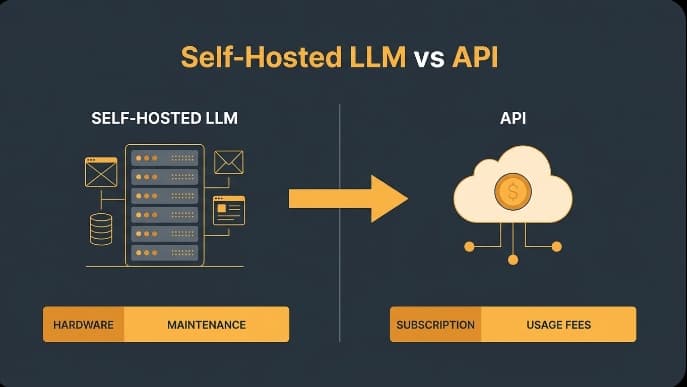
Self-Hosted LLM vs API: Decision and Cost Framework
Self-hosted LLM vs API is a deployment decision that affects cost, control, speed, privacy, and long-term maintenance.
A self-hosted LLM runs on your own GPUs, cloud servers, or private infrastructure. Your team manages model serving, scaling, monitoring, security, and updates.
An LLM API sends requests to external API providers, which run the model on their own infrastructure and usually charge by token usage. For most teams, APIs are easier and faster to start with. Self-hosting becomes more attractive when usage is high, traffic is steady, data control is critical, or API cost becomes hard to manage.
There is no universal winner. The right choice depends on your token volume, model size, GPU utilization, latency needs, privacy requirements, and engineering capacity.
What Is a Self-Hosted LLM?
A self-hosted LLM is a language model that runs on infrastructure controlled by your organization.
This infrastructure can include on-premise GPUs, private cloud servers, dedicated GPU instances, or managed Kubernetes clusters. Your team controls where the model runs, how requests are processed, how data is stored, and how the system scales. With a self-hosted LLM, your application sends the prompt directly to your own model server. The model generates the response without sending the prompt to an external model provider.
Basic self-hosted workflow:
User → Application → Self-hosted model → Response
Self-hosting gives teams more control over data privacy, infrastructure, model customization, and inference settings. It also creates more responsibility. Your team must manage GPU capacity, deployment, performance tuning, monitoring, failure recovery, and model updates.
Self-hosting works best when an organization has stable workloads, strong infrastructure skills, and enough traffic to keep GPUs efficiently used.
What Is an LLM API?
An LLM API lets your application access a remote language model through an internet endpoint.
Your system sends a prompt to the API provider. The provider runs inference on its infrastructure and returns the generated response. API providers handle model hosting, GPU scheduling, load balancing, scaling, security, and uptime.
Basic API workflow:
User → Application → API Provider → Model → Response
API providers such as OpenAI, Anthropic, Google, Cohere, and others expose model access through a standard request pattern. Some platforms also give developers access to several API providers through one integration layer, making it easier to switch models or manage usage from a single place.
API pricing usually depends on token usage. Input tokens come from prompts, instructions, documents, and context. Output tokens come from the model response. Longer prompts and longer outputs usually increase API cost.
APIs work best when teams need fast deployment, access to frontier models, lower infrastructure burden, and flexible usage.
Self-Hosted LLM vs API: Key Differences

| Factor | Self-Hosted LLM | LLM API |
|---|---|---|
| Infrastructure ownership | You manage it | Provider manages it |
| Setup speed | Slower | Faster |
| Upfront cost | Higher | Lower |
| Ongoing maintenance | Your team | Provider |
| Data control | Higher | Depends on provider terms |
| Scaling | Manual or custom | Provider-managed |
| Hardware required | Yes | No |
| Model customization | Stronger | More limited |
| Operational complexity | High | Low |
| Cost model | GPU, infrastructure, engineering | Token, request, or subscription-based |
The main trade-off is control versus convenience. Self-hosting gives you more control, but it requires more technical work. APIs reduce operational load, but API cost can rise quickly as token usage grows.
Understanding the Real Cost of Self-Hosting
Self-hosted LLM cost goes beyond GPU rental. The full cost includes compute, storage, networking, monitoring, security, engineering time, and incident response.
GPU Costs
GPU pricing depends on model size, memory requirements, throughput needs, and cloud provider rates. Larger models need more GPU memory and stronger hardware to maintain usable latency.
Illustrative monthly GPU ranges:
| GPU | Estimated Monthly Cost |
|---|---|
| NVIDIA L40S | $1,500 to $3,000 |
| NVIDIA A100 80GB | $2,000 to $5,000 |
| NVIDIA H100 | $4,000 to $12,000+ |
These are example ranges only. Real cost depends on provider, region, reserved pricing, spot pricing, usage hours, and support requirements.
Low traffic makes self-hosting expensive because GPUs may sit idle. High and steady traffic can make self-hosting more efficient because infrastructure cost spreads across more requests.
Infrastructure Costs Beyond GPUs
Production LLM systems need more than model weights and a GPU.
Self-hosted deployments often require:
- Storage for model files, logs, and data
- Networking for request traffic
- Load balancing for availability
- Monitoring for latency and GPU usage
- Autoscaling or capacity planning
- Security controls
- Backup and recovery systems
- Observability dashboards
- Deployment pipelines
These costs increase with traffic, uptime requirements, compliance needs, and system complexity.
Engineering Costs
Self-hosted LLMs need continuous engineering work. Teams must handle deployment, scaling, monitoring, updates, debugging, optimization, and failures. This work does not end after the model goes live.
Engineering cost becomes a major factor when the team needs:
- Low latency
- High uptime
- Multi-GPU serving
- Fine-tuned models
- Private deployment
- Custom routing
- Model version control
A self-hosted LLM may reduce API cost at scale, but only when the team has the skills and workload volume to justify the operational effort.
Understanding API Cost

API cost usually follows token usage. You pay for the input tokens sent to the model and the output tokens generated by the model.
Simple formula:
API cost = input token cost + output token cost
A token is a unit of text processed by the model. Short requests use fewer tokens. Long prompts, large documents, chat history, and long answers use more tokens.
Several factors affect API cost:
- Model choice
- Input length
- Output length
- Context window size
- Request volume
- Cached token support
- Tool calls or function calls
- Multimodal inputs
- Provider pricing rules
Output tokens often cost more than input tokens because generation requires more compute than reading the prompt.
Example Model Pricing
The table below is for illustration only. Pricing changes often, and teams should confirm current rates with the provider or platform before making cost decisions.
| Model | Input Cost | Output Cost |
|---|---|---|
| Low-cost text model | $0.05 per 1M tokens | $0.40 per 1M tokens |
| Lightweight chat model | $0.29 per 1M tokens | $1.43 per 1M tokens |
| Mid-range model | $0.86 per 1M tokens | $4.29 per 1M tokens |
| Premium reasoning model | $2.50 per 1M tokens | $10.00 per 1M tokens |
| Advanced reasoning model | $15.00 per 1M tokens | $120.00 per 1M tokens |
The model you choose can change API cost more than the number of requests alone. A simple classification task may not need a premium model. A complex coding or reasoning task may justify a more expensive model if accuracy matters.
API Cost Calculation Example
Here is a simple example.
Assume a workload uses:
- 1 million input tokens
- 1 million output tokens
- $0.15 per 1M input tokens
- $0.60 per 1M output tokens
Cost calculation:
| Token Type | Usage | Rate | Cost |
|---|---|---|---|
| Input tokens | 1M | $0.15 | $0.15 |
| Output tokens | 1M | $0.60 | $0.60 |
| Total | 2M | $0.75 |
At small usage levels, APIs are often cheaper than self-hosting. At high usage levels, repeated token charges can become a major operating cost.
Hidden Costs Most Teams Miss
Many teams compare GPU cost against API pricing and stop there. That gives an incomplete picture.
Hidden Self-Hosting Costs
Self-hosting may include:
- Downtime risk when GPU clusters fail
- Engineering overhead for deployment and scaling
- Monitoring and logging tools
- Security and compliance reviews
- Backup and disaster recovery
- Model update work
- GPU shortages or price changes
- Performance tuning
- On-call support
These costs matter because self-hosted LLMs become production systems, not simple experiments.
Hidden API Costs
APIs can also create hidden costs, including:
- Usage spikes
- Rate limit upgrades
- Vendor lock-in
- Data transfer costs
- Model deprecations
- Pricing changes
- Retry costs from failed requests
- Long prompt costs
- Long output costs
- Multi-provider management work
API providers reduce infrastructure complexity, but teams still need cost monitoring, usage controls, and fallback planning.
Cost Comparison Examples
The right deployment model depends on workload size and usage pattern.
Example 1: Internal Team Assistant
A company builds an internal assistant for 500 employees.
The assistant processes around 500,000 tokens per day. Usage changes by workday, team activity, and employee adoption.
In this case, API providers may be cheaper and easier than self-hosting. The workload may not justify dedicated GPU infrastructure, especially if usage is uneven.
Likely fit: API
Example 2: Customer Support Chatbot
A support chatbot handles 50,000 conversations per day.
The system processes millions of tokens daily and runs continuously. Traffic is steady, and the team can forecast usage.
At this level, self-hosting may become more competitive if the organization can maintain high GPU utilization and manage infrastructure well.
Likely fit: self-hosted LLM or hybrid
Example 3: AI Search Platform
An AI search product processes hundreds of millions of tokens each month.
Multiple products or teams may share the same infrastructure. Usage is predictable, and latency control matters.
Self-hosting can become attractive because GPU cost spreads across a large workload. APIs may still support advanced reasoning or fallback tasks.
Likely fit: self-hosted LLM or hybrid
When Self-Hosted LLMs Make Sense
Organizations choose self-hosted LLMs when control and cost stability matter more than speed of setup.
Self-hosting is a strong fit when:
- Data privacy requirements are strict
- Prompts and outputs cannot leave internal systems
- Token volume is high and steady
- GPU utilization can stay efficient
- The team has infrastructure expertise
- The organization needs model customization
- Long-term API cost is too high
- Custom fine-tuned models are needed
- Latency and deployment control are important
Self-hosting often appears in healthcare, finance, research, government, and large technology environments where control and predictable usage matter.
When APIs Make Sense
Organizations choose APIs when speed, flexibility, and lower operational work matter more than infrastructure control.
APIs are a strong fit when:
- The product is an MVP or prototype
- Usage is low or unpredictable
- Engineering resources are limited
- The team needs fast deployment
- The product needs frontier models
- Model experimentation matters
- Traffic changes often
- The team does not want GPU operations
Startups and small teams often begin with APIs because they can launch faster and avoid infrastructure complexity.
Why Hybrid Deployments Are Growing

Hybrid deployments combine self-hosted models and API models within the same system.
A hybrid setup may route:
- Simple requests to self-hosted models
- Complex reasoning tasks to premium APIs
- Long-context tasks to APIs when local memory is limited
- High-volume tasks to local models
- Sensitive requests to private infrastructure
- Low-risk tasks to lower-cost API models
This approach helps teams balance cost, quality, privacy, and performance.
AI gateway and routing layers can support hybrid deployment by sending requests to the right model based on task complexity, token cost, latency needs, or provider availability.
A platform such as Tokenware can fit this layer by helping teams manage model access, token usage, and multi-provider routing from one integration point. The value depends on the team’s workload, model choices, and API integration needs.
Decision Framework
Use this framework as a starting point.
| Situation | Likely Fit |
|---|---|
| Startup MVP | API |
| Prototype application | API |
| Low or unpredictable usage | API |
| Internal enterprise tool | Depends |
| Regulated workload | Self-hosted LLM |
| High-volume customer support | Self-hosted LLM or hybrid |
| Research environment | Self-hosted LLM |
| Rapid model testing | API |
| Multi-model architecture | Hybrid |
| Sensitive data workflow | Self-hosted LLM or hybrid |
The best choice is not only about cost. It also depends on risk, team skills, speed, privacy, and reliability.
Quick Decision Checklist
Choose API when:
- You need to launch quickly
- Usage is low or uncertain
- You want provider-managed scaling
- You need access to frontier models
- You do not want to manage GPUs
- Your team is still testing product-market fit
Choose self-hosted LLM when:
- Usage is high and stable
- Data privacy requirements are strict
- You have GPU and infrastructure expertise
- You need deep model customization
- You can keep hardware well utilized
- Long-term API cost is becoming too high
Choose hybrid when:
- You need both privacy and flexibility
- Some tasks need premium models
- Some tasks can run on cheaper local models
- You want cost control without giving up API access
- Your workload includes different task types
Conclusion
Self-hosted LLM and API models solve the same problem in different ways.
A self-hosted LLM shifts cost into GPUs, infrastructure, storage, networking, and engineering work. It fits stable, high-volume workloads where data control, customization, and long-term cost stability matter.
An LLM API shifts cost into token usage paid to API providers. It fits teams that need fast deployment, flexible usage, managed scaling, and access to advanced models without managing infrastructure.
For low or unpredictable usage, APIs are usually the better starting point. For high and steady usage, self-hosting can become more cost-efficient when GPU utilization stays strong. Many mature teams use a hybrid setup, with self-hosted models for predictable workloads and APIs for complex or specialized tasks.
The right decision depends on workload size, token usage, API cost, provider requirements, data control, infrastructure capacity, and long-term operating goals.
Frequently Asked Questions
1. What is the main difference between a self-hosted LLM and an API?
A self-hosted LLM runs on infrastructure controlled by your organization. An API uses a model hosted by an external provider.
2. Is a self-hosted LLM cheaper than an API?
Not always. Self-hosting can be cheaper at high and steady usage, but APIs are often cheaper for low or unpredictable workloads.
3. How does token usage affect API cost?
API providers usually charge for input and output tokens. Longer prompts, larger context, and longer responses increase total cost.
4. Why does GPU utilization matter for self-hosting?
Low GPU utilization means you pay for hardware that is not doing much work. High utilization spreads infrastructure cost across more requests.
5. When should a startup use APIs instead of self-hosting?
A startup should usually use APIs when it needs speed, flexibility, low setup cost, and access to advanced models without managing infrastructure.
6. When should an enterprise consider self-hosting?
An enterprise should consider self-hosting when usage is high, data privacy is strict, and the team can manage production infrastructure.
7. What hidden costs come with self-hosting?
Hidden costs include engineering time, monitoring, security, downtime risk, backups, scaling, and model updates.
8. What hidden costs come with APIs?
Hidden costs include traffic spikes, rate limits, vendor lock-in, model migrations, retries, and pricing changes.
9. What is a hybrid LLM deployment?
A hybrid deployment uses both self-hosted models and API models. Each request is routed based on cost, privacy, latency, or task complexity.
10. What should teams calculate before choosing?
Teams should estimate monthly token usage, model requirements, API cost, GPU cost, engineering effort, latency needs, and data privacy requirements.