
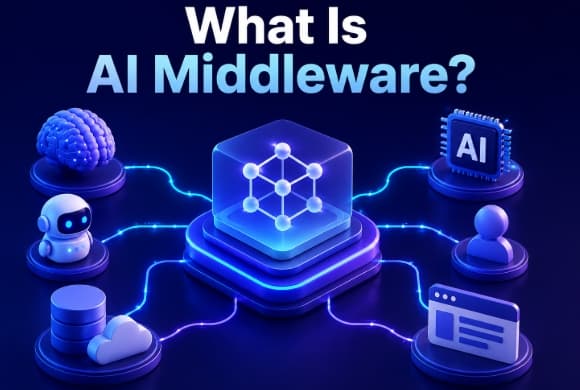
What Is AI Middleware? How It Connects AI Models, Agents, and Applications
Modern AI applications increasingly combine models, agents, APIs, databases, and business systems. As these components grow, developers face more work around routing requests, managing data access, connecting tools, enforcing security, and coordinating complex workflows.
This makes the architecture behind AI applications as important as the models themselves. This guide explains where the middleware layer fits, how it connects different AI components, and how it supports reliable AI integration as applications scale.
What Is AI Middleware?

AI middleware is a software layer that connects AI applications with models, agents, APIs, data sources, and enterprise systems. Instead of connecting every application directly to every AI service, developers place middleware between these components. The middleware provides shared controls for communication, routing, security, monitoring, and integration. A simplified architecture looks like this:
Users
↓
AI Application
↓
AI Middleware
├── AI Models
├── AI Agents
├── APIs and Tools
├── Databases
└── Enterprise Systems
The middleware acts as a control and integration layer. It abstracts differences between model providers and gives applications a consistent way to access AI capabilities.
Where AI Middleware Fits in the AI Stack
AI middleware sits between the application layer and the AI infrastructure that powers models, agents, tools, APIs, and enterprise data. It provides the connection layer between what users interact with and the services that process AI requests.
An application manages the user experience and business logic. AI models generate responses and process tasks. AI agents use models, tools, and external data to complete multi-step tasks. Databases and APIs provide the information and services these systems need.
The middleware connects these components through a common integration layer. It handles authentication, model routing, data access, tool calls, monitoring, and policy enforcement.
For example, an application can send one request to the middleware instead of connecting directly to multiple model providers. The middleware selects the appropriate model, checks permissions, retrieves context, and routes the request. For complex workflows, agent orchestration coordinates the required agents, models, and tools. This architecture becomes more valuable as applications add more AI models, AI agents, data sources, and integrations.
How Does AI Middleware Work?

A typical request passes through several stages.
1. The Application Sends a Request
The application sends a prompt, task, or structured request to the middleware. The request might ask an AI system to answer a question, summarize a document, call an API, or complete a business workflow.
2. The Middleware Validates the Request
The middleware checks authentication, permissions, rate limits, and other policies before forwarding the request. This gives teams a central point for controlling access to AI services.
3. The Middleware Selects a Model or Agent
A routing layer evaluates the request and selects an appropriate model or agent. Routing rules might consider capability, latency, cost, availability, or workload requirements.
4. The Middleware Retrieves Context
The system might retrieve information from databases, knowledge bases, vector stores, or other enterprise sources. This information gives the model or agent the context required to process the request.
5. Tools and APIs Execute Actions
If the task requires external actions, middleware manages access to APIs and tools. For example, an AI assistant might need to retrieve an order, check inventory, query a database, or create a support ticket.
6. Policies and Guardrails Are Applied
Middleware also provides controls around AI requests and responses. These controls might include access policies, data protection rules, content filters, usage limits, and tool permissions.
7. Usage and Performance Are Recorded
The middleware records operational data such as latency, errors, token usage, model selection, and request volume. Teams use these metrics to troubleshoot applications and manage AI spending.
What Does AI Middleware Do?
The capabilities vary between platforms, but several functions appear across modern architectures.
Model Routing
Model routing directs requests to different models based on predefined rules. A system might use a smaller model for simple tasks and a more capable model for complex reasoning. Routing also helps teams switch providers when a service becomes unavailable or fails to meet performance requirements.
Agent Orchestration
Agent orchestration coordinates agents, models, tools, and workflows to complete multi-step tasks. For example, one agent might retrieve customer information while another analyzes the information. A coordinator then combines their outputs and sends the result to the application.
API and Tool Integration
Middleware provides a consistent way for AI systems to access external services. This reduces the need to build separate integrations for every application, model, or agent.
Context and Data Management
AI systems often need access to business data before generating a response. Middleware helps connect models and agents with databases, document stores, search systems, and retrieval pipelines.
Security and Access Control
A centralized middleware layer provides a place to enforce authentication, authorization, rate limits, and access policies. Teams also gain greater control over which models, tools, and data sources each application or agent can access.
Observability
AI workloads require monitoring beyond standard application metrics. Middleware helps track model latency, token consumption, request failures, tool calls, response times, and provider performance.
AI Middleware vs Traditional Middleware
Traditional middleware connects software applications, services, databases, and other infrastructure. AI middleware performs similar integration work but adds controls designed for AI workloads.
| Traditional Middleware | AI Middleware |
|---|---|
| Connects applications and services | Connects applications, models, agents, and services |
| Service routing | Model and provider routing |
| API management | AI API and tool management |
| Application monitoring | AI-specific observability |
| Standard access controls | AI model, agent, and tool permissions |
| Service workflows | AI and multi-step workflows |
The main difference lies in the types of systems being connected and the controls required to operate AI workloads.
AI Middleware vs AI Gateway
An AI gateway primarily manages traffic between applications and AI providers. Typical gateway functions include authentication, rate limiting, model routing, logging, and provider management.
AI middleware covers a broader scope. It might include gateway capabilities while also managing agents, tools, data, orchestration, policies, and enterprise integrations.
The two concepts overlap, but they do not always represent the same architectural layer.
AI Middleware vs AI Orchestration
AI orchestration focuses on coordinating models, agents, tools, and workflows.Middleware provides the broader integration and control layer around these components.
For example, orchestration might determine which agent performs the next task. Middleware might authenticate the request, provide access to the required tool, route a model request, apply policies, and record the resulting telemetry. AI Orchestration therefore represents one capability within a broader middleware architecture.
How AI Middleware Connects Models, Agents, and Applications
The main value of middleware comes from connecting different parts of an AI system without forcing every component to communicate directly.
Connecting Applications to Models
Applications often need to work with multiple models or providers. Middleware provides a common interface and manages routing behind the scenes. This reduces application-level dependencies on individual providers.
Connecting Agents to Tools and Data
Agents often need external information and tools to complete tasks. Middleware manages these connections and controls access. An agent might access a CRM, database, search engine, payment system, or internal API through the middleware layer.
Connecting Multiple Agents
Complex workflows might involve several specialized agents. Middleware helps coordinate communication between them and manage the tools and models each agent requires. This approach also gives teams a central location for monitoring multi-agent activity.
Key Components of an AI Middleware Architecture

A typical architecture might include:
- • API gateway for request management
- • Model router for provider and model selection
- • Agent orchestrator for multi-step workflows
- • Tool connectors for external services
- • Context manager for data retrieval
- • Policy engine for security and governance
- • Authentication and authorization services
- • Observability layer for logs and metrics
- • Rate limiter for traffic control
- • Failover system for provider reliability
- • Cost tracking for usage management
- • Cache layer for frequently repeated requests
Not every deployment needs every component. The architecture should match the complexity of the application.
Benefits of AI Middleware
AI middleware provides several practical benefits for teams building and operating AI applications.
Lower Integration Complexity
Teams manage connections through a shared layer instead of maintaining separate integrations across every application.
Model Flexibility
Applications gain greater flexibility when switching between providers or models.
Centralized Security
Authentication, authorization, policies, and access controls sit in a common control layer.
Better Reliability
Routing, retries, fallback providers, and health checks help reduce service disruptions.
Improved Cost Control
Usage tracking and routing rules help teams understand where AI spending comes from and select models according to workload requirements.
Better Visibility
Centralized logs and metrics provide a clearer view of model performance, errors, latency, and usage.
How to Choose AI Middleware
Evaluate a platform based on your architecture, workload, security requirements, and operational needs.
- • Model and provider support: Check whether the platform supports the models and providers your applications require.
- • Agent and workflow capabilities: Look for support for multi-step workflows, tool calls, and agent-based applications.
- • API and tool integrations: Check how easily you can connect external APIs, databases, and business tools.
- • Authentication and authorization: Ensure the platform supports secure identity verification and access controls.
- • Routing and failover: Look for intelligent routing and fallback options when a model or provider becomes unavailable.
- • Observability and tracing: Check whether you can monitor requests, latency, errors, model usage, and workflow activity.
- • Rate limiting: Confirm that you can control request volumes and protect services from excessive traffic.
- • Cost tracking: Look for usage and spending data across models, applications, teams, or projects.
- • Deployment options: Check whether the platform supports your preferred cloud, on-premises, or hybrid environment.
- • Scalability: Ensure the platform supports your expected request volume and future workload growth.
- • Data and security controls: Review encryption, data handling, access policies, and compliance features.
- • AI protocol support: Check support for relevant standards and protocols used by your AI stack.
Do not choose a platform based only on the number of supported models. Integration quality, reliability, security, observability, and operational control matter more when running AI applications in production.
AI Middleware Architecture Example
Consider an AI customer support application. A customer sends a question through the application. The request reaches the middleware layer, which authenticates the user and applies rate limits. The middleware retrieves relevant customer information from a database. A routing component selects a suitable model. An agent then uses a support API to check the customer's order status.
The middleware records the model used, tool calls, latency, token usage, and errors. The final response returns to the application.
Customer
↓
AI Application
↓
AI Middleware
├── Authentication
├── Model Router
├── Agent Orchestration
├── Context Retrieval
├── Policy Engine
└── Observability
↓
Models + Tools + Data
↓
Business Systems
This architecture separates application logic from AI infrastructure and gives teams centralized control over the AI stack.
Conclusion
The value of AI middleware becomes clear as AI systems grow beyond a single model or application. It gives development teams a central way to manage model access, agent workflows, tool calls, data connections, security, and performance.
For simple AI applications, a direct connection to one provider might be sufficient. Larger systems need stronger control as they introduce multiple AI models, AI agents, APIs, and enterprise data. Agent orchestration also requires reliable communication between different components.
Choosing the right architecture depends on your workload, security requirements, integration needs, and scale. When these requirements increase, a well-designed middleware layer helps teams build AI systems that are easier to manage, monitor, and adapt.
Frequently Asked Questions
1. How does AI middleware support AI integration?
It provides shared interfaces for connecting applications with models, tools, APIs, and data services.
2. What is the benefit of using multiple AI models?
Different models provide options for cost, reasoning capability, speed, context size, and specialized tasks.
3. How does AI infrastructure support production workloads?
It provides routing, monitoring, security, scaling, rate control, reliability, and operational management.
4. What is the role of a model routing layer?
It selects a suitable model based on cost, latency, capability, or availability.
5. How does request routing work?
Routing rules inspect request attributes and direct traffic to the appropriate endpoint.
6. How does failover work in AI infrastructure?
The system detects provider failures and redirects requests to an available endpoint.
7. How are API rate limits enforced?
Traffic controls track quotas and apply throttling, queuing, or rejection when limits are reached.
8. What role do AI agents play in automated workflows?
They interpret tasks, make decisions, call tools, and execute multiple steps toward an objective.
9. How does authentication work for AI services?
The system validates API keys, OAuth tokens, service accounts, or other credentials.
10. What does agent orchestration manage?
It coordinates task sequencing, state, dependencies, communication, and execution across multiple agents.