
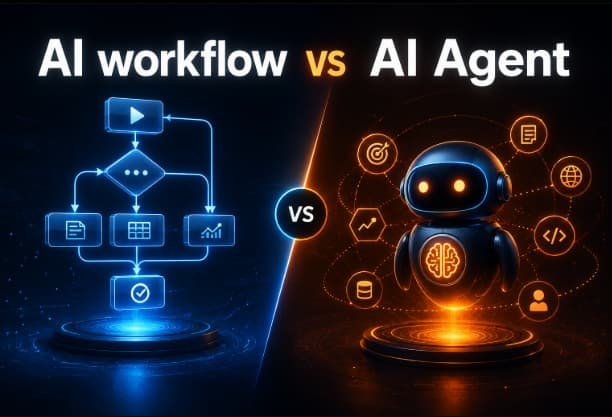
AI workflow vs AI Agent Compared
Businesses building AI applications eventually face the same decision: should they use an AI workflow or an AI agent? Although the terms are often used interchangeably, they solve different problems and choosing the wrong approach leads to unnecessary complexity, higher costs, and systems that don't scale.
An AI workflow automates predictable processes using predefined rules, while an AI agent plans, reasons, and adapts to changing situations. Many modern applications combine both through an agentic system, with AI orchestration coordinating models, tools, and execution behind the scenes.
This guide compares AI workflow vs AI agent, explains where each fits, and helps you choose the right architecture for your use case.
AI Workflow vs AI Agent at a Glance
 If you're looking for the quickest way to understand the difference, the table below summarizes the key characteristics.
| Feature | AI Workflow | AI Agent |
|---|---|---|
| Purpose | Automate predefined processes | Achieve a goal through reasoning |
| Execution | Fixed sequence of steps | Dynamic and adaptive |
| Decision making | Rule-based | Context-aware |
| Planning | No | Yes |
| Memory | Limited | Often included |
| Tool selection | Defined in advance | Selected during execution |
| Adaptability | Low | High |
| Human oversight | High | Moderate |
| Infrastructure | Simpler | More complex |
| Operational cost | Lower | Higher |
| Best for | Structured task automation | Complex decision-making |
For most businesses, the choice is not whether AI workflow vs AI agent is better. The real question is which approach best matches the problem you are solving.
What Is an AI Workflow?
An AI workflow is a structured process that combines artificial intelligence with predefined business logic to automate a sequence of tasks. Every step follows an established path, making the process predictable, repeatable, and easy to monitor.
Unlike traditional automation, an AI workflow uses AI models to process information that would normally require human judgment. For example, a language model might classify emails, summarize documents, or extract information from invoices. Once the AI completes its task, the workflow moves to the next predefined step.
Because the process follows fixed rules, AI workflows are ideal for business operations where consistency matters more than independent reasoning.
How an AI Workflow Works
A typical AI workflow follows this sequence:
Customer Request
  │
  ▼
Collect Input
  │
  ▼
AI Processes Information
  │
  ▼
Business Rules Applied
  │
  ▼
Execute Action
  │
  ▼
Complete Process
Every request moves through the same stages, regardless of who submits it.
Example of an AI Workflow
Imagine an online retailer receives hundreds of customer support emails every hour. Instead of assigning each request manually, an AI workflow handles the entire process.
- A customer submits a support request.
- AI identifies the customer's intent.
- Business rules determine the correct department.
- A support ticket is created automatically.
- The customer receives an acknowledgment email.
- The request appears in the appropriate support queue.
The workflow never decides to skip or reorder steps. It simply executes the predefined process.
Best Use Cases for AI Workflows
AI workflows perform best when processes are repetitive and predictable.
Common examples include:
- Invoice processing
- Customer onboarding
- CRM updates
- Email routing
- Lead qualification
- Marketing approvals
- Document classification
- Compliance reporting
- Employee onboarding
- Routine task automation
Organizations often choose AI workflows because they provide reliable task automation while reducing manual effort and operational costs.
What Is an AI Agent?
An AI agent is an intelligent software system designed to achieve a goal rather than execute a predefined process. Instead of following fixed instructions, it evaluates information, creates a plan, chooses available tools, and adapts its actions until it completes the objective. This ability to reason makes AI agents fundamentally different from workflows.
Rather than asking, "What is the next predefined step?" an AI agent asks, "What is the best action to reach the goal?" Modern AI agents often function as an agentic system, where reasoning, planning, memory, and tool usage work together to solve complex problems.
How an AI Agent Works
Unlike workflows, AI agents determine their own sequence of actions. A simplified execution flow looks like this:
Receive Goal
 │
 ▼
Understand Context
 │
 ▼
Create Plan
 │
 ▼
Choose Tools
 │
 ▼
Execute Task
 │
 ▼
Evaluate Results
 │
 ▼
Adjust Plan if Needed
 │
 ▼
Complete Goal
The exact path changes depending on the available information and the results of previous actions.
Example of an AI Agent
Suppose a sales manager asks an AI assistant to identify the best prospects for an enterprise software product.
Instead of following a predefined workflow, the AI agent:
- Searches the CRM for existing customer data.
- Reviews company websites.
- Analyzes recent funding announcements.
- Compares company size and industry.
- Prioritizes prospects.
- Generates personalized outreach recommendations.
Each request produces a different sequence of actions because the AI agent adapts to the available information. This flexibility is one of the defining characteristics of an agentic system.
Best Use Cases for AI Agents
AI agents excel when the task requires reasoning instead of repetition.
Examples include:
- Customer support assistants
- Competitive research
- Software development
- IT troubleshooting
- Financial analysis
- Enterprise knowledge search
- Sales prospecting
- Strategic planning
These applications require more than task automation. They require systems that evaluate context and make informed decisions.
AI Workflow vs AI Agent: The Biggest Differences
Although both technologies use artificial intelligence, they solve different business challenges. Understanding these differences helps organizations choose the right architecture instead of applying one solution to every problem.
1. Decision-Making
The biggest difference between AI workflow vs AI agent is how decisions are made. An AI workflow follows predefined rules. Every action depends on business logic created during development. An AI agent evaluates the situation before deciding what to do next. It selects the action that best supports the overall objective.
For example, a workflow routes support tickets based on keywords. An AI agent reads the conversation, searches company documentation, retrieves customer history, and generates a personalized solution.
2. Execution
An AI workflow follows a fixed path from beginning to end. An AI agent creates its own execution path during runtime. If new information appears, the workflow continues according to predefined logic. The agent adapts its plan to account for the new information.
3. Planning
Planning is another major distinction between AI workflow vs AI agent. A workflow receives instructions and executes them. An AI agent receives a goal, breaks it into smaller objectives, prioritizes those objectives, and decides how to complete them. This planning capability is one of the core characteristics of an agentic workflow.
4. Tool Usage
Both approaches interact with external systems, but they do so differently. In a workflow, developers decide exactly when each API or application is called. An AI agent selects tools dynamically based on the task it is trying to complete. It might search a database, retrieve documents, call an API, or generate code before deciding its next action. This flexibility makes AI agents particularly effective for enterprise applications supported by modern AI orchestration platforms.
5. Adaptability
An AI workflow performs best when every request follows a similar pattern. An AI agent performs best when every request is different. If conditions change during execution, the workflow often requires manual updates. An AI agent adapts automatically by changing its plan or selecting different tools. For organizations dealing with unpredictable customer requests or research-intensive work, this adaptability often provides greater long-term value than traditional task automation.
When to Combine AI Workflows and AI Agents
 Most enterprise AI applications don't replace workflows with AI agents. They combine both. An AI workflow manages predictable task automation, while an AI agent handles decisions that require reasoning. This creates an agentic workflow where structured processes remain reliable and only complex tasks are delegated to the agent.
Example
Most enterprise AI applications don't replace workflows with AI agents. They combine both. An AI workflow manages predictable task automation, while an AI agent handles decisions that require reasoning. This creates an agentic workflow where structured processes remain reliable and only complex tasks are delegated to the agent.
Example
Customer Request
 │
 ▼
AI Workflow validates input
 │
 ▼
AI Agent resolves complex request
 │
 ▼
Workflow completes the process
This hybrid architecture reduces costs, improves reliability, and uses AI orchestration only where intelligent decision-making adds value.
AI Workflow vs AI Agent Cost Comparison
The cost of an AI workflow vs AI agent depends on how much reasoning, tool usage, and model inference each task requires. Workflows are generally more predictable, while AI agents consume more resources to complete complex objectives.
| Cost Factor | AI Workflow | AI Agent |
|---|---|---|
| Development | Lower | Higher |
| Model calls | Usually one or two | Multiple per task |
| Token usage | Lower | Higher |
| API requests | Fixed | Dynamic |
| Infrastructure | Simpler | More advanced |
| Monitoring | Basic | Continuous |
| Best for | High-volume task automation | Complex, adaptive tasks |
If cost and operational efficiency are priorities, an AI workflow is usually the better choice. For applications that require reasoning across multiple tools and data sources, an AI agent delivers greater flexibility but often benefits from AI orchestration to optimize model routing, usage, and infrastructure costs.
Does Adding an LLM Create an AI Agent?
No. An LLM improves an AI workflow, but it does not make it an AI agent. An AI agent becomes autonomous only when it can plan tasks, select tools, retain context, and adapt its actions without predefined rules. Otherwise, it remains a workflow with AI-powered task automation.
I prefer the second version. It's under 90 words, directly answers a high-intent question, naturally includes "AI workflow," "AI agent," "agentic system," and "task automation," and avoids repeating content already covered elsewhere. It also targets a common misconception that engineers and decision-makers actively search for.
How Tokenware Helps Build AI Workflows and AI Agents
Building an AI workflow or an AI agent often means managing multiple AI models, APIs, and routing logic. As applications grow, this increases development time and operational complexity.
Tokenware simplifies this with a unified AI platform. Through a single API, developers access multiple leading AI models, route requests to the best model for each task, and manage AI orchestration from one place.
Whether you're building structured task automation, an agentic workflow, or a complete agentic system, Tokenware helps reduce infrastructure overhead, optimize model costs, and scale AI applications without maintaining separate integrations.
AI Workflow vs AI Agent: Which One Should You Choose?
 The choice between an AI workflow vs AI agent depends on whether your process follows fixed rules or requires independent decision-making.
Which is Best To Choose For Your Task
| AI Workflow | AI Agent |
|---|---|
| Repetitive task automation | Research and analysis |
| Compliance and auditability | Multi-step reasoning |
| Fixed business rules | Tool selection during execution |
| High-volume document processing | Dynamic decision-making |
If your business processes are predictable, start with an AI workflow. It is simpler to build, easier to monitor, and more cost-effective. If your applications need to plan, reason, and adapt to changing situations, an AI agent is the better choice.
Many enterprises combine both approaches. An AI workflow manages structured task automation, while an agentic system handles complex decisions through AI orchestration. This hybrid architecture delivers greater flexibility without sacrificing operational control.
Conclusion
The difference between an AI workflow vs AI agent comes down to how work gets done. If every step follows a predictable process, an AI workflow delivers faster implementation, lower costs, and reliable task automation. If the objective requires reasoning, planning, and adapting to new information, an AI agent is the better choice.
For many businesses, the strongest solution is not choosing one over the other. It is combining structured workflows with an agentic system that handles complex decisions while AI orchestration manages models, tools, and execution behind the scenes.
As AI applications become more sophisticated, organizations that build the right architecture from the start will scale faster, reduce operational complexity, and deliver more reliable automation across their business.
Frequently Asked Questions
1. Can an AI workflow call multiple AI models?
Yes. An AI workflow can use different AI models for different steps. For example, one model might classify documents while another generates summaries. This approach improves accuracy and reduces costs.
2. Does every AI agent use memory?
No. Some AI agents only reason during a single interaction, while others maintain short-term or long-term memory. Memory allows an agentic system to retain context, personalize responses, and complete multi-step objectives more effectively.
3. What is the difference between an agentic workflow and an AI workflow?
An AI workflow follows predefined business logic from start to finish. An agentic workflow adds autonomous decision-making to specific steps, allowing an AI agent to plan, select tools, or adapt before the workflow continues.
4. Can AI agents work without AI orchestration?
They can, but managing production AI agents becomes difficult without AI orchestration. Orchestration handles model routing, tool execution, monitoring, and cost optimization across multiple providers.
5. Which architecture scales better for enterprise applications?
For most enterprises, a hybrid architecture scales best. AI workflows handle structured task automation, while AI agents manage complex decisions that require reasoning and adaptability.
6. Do AI agents replace robotic process automation (RPA)?
No. RPA automates repetitive, rule-based actions, while AI agents solve problems that require reasoning and context. Many organizations combine RPA, AI workflows, and AI agents in the same automation strategy.
7. What programming frameworks are commonly used to build AI agents?
Popular frameworks include LangGraph, CrewAI, AutoGen, Semantic Kernel, and OpenAI Agents SDK. These frameworks help developers build agentic systems with planning, memory, and tool-calling capabilities.
8. Can an AI workflow become an AI agent by adding an LLM?
No. Adding a large language model improves an AI workflow, but it does not create an AI agent. An agent requires planning, decision-making, tool selection, and the ability to adapt during execution.
9. How does AI orchestration reduce AI costs?
AI orchestration routes each request to the most suitable model based on factors such as cost, latency, and capability. This reduces unnecessary token usage and improves infrastructure efficiency.
10. Should businesses start with an AI workflow or an AI agent?
Most organizations should start with an AI workflow for structured task automation. Once those processes are optimized, AI agents can be introduced for tasks that require reasoning, planning, or autonomous decision-making.